Rome — Paul Klerr, American Academy in Rome
À propos de ce document
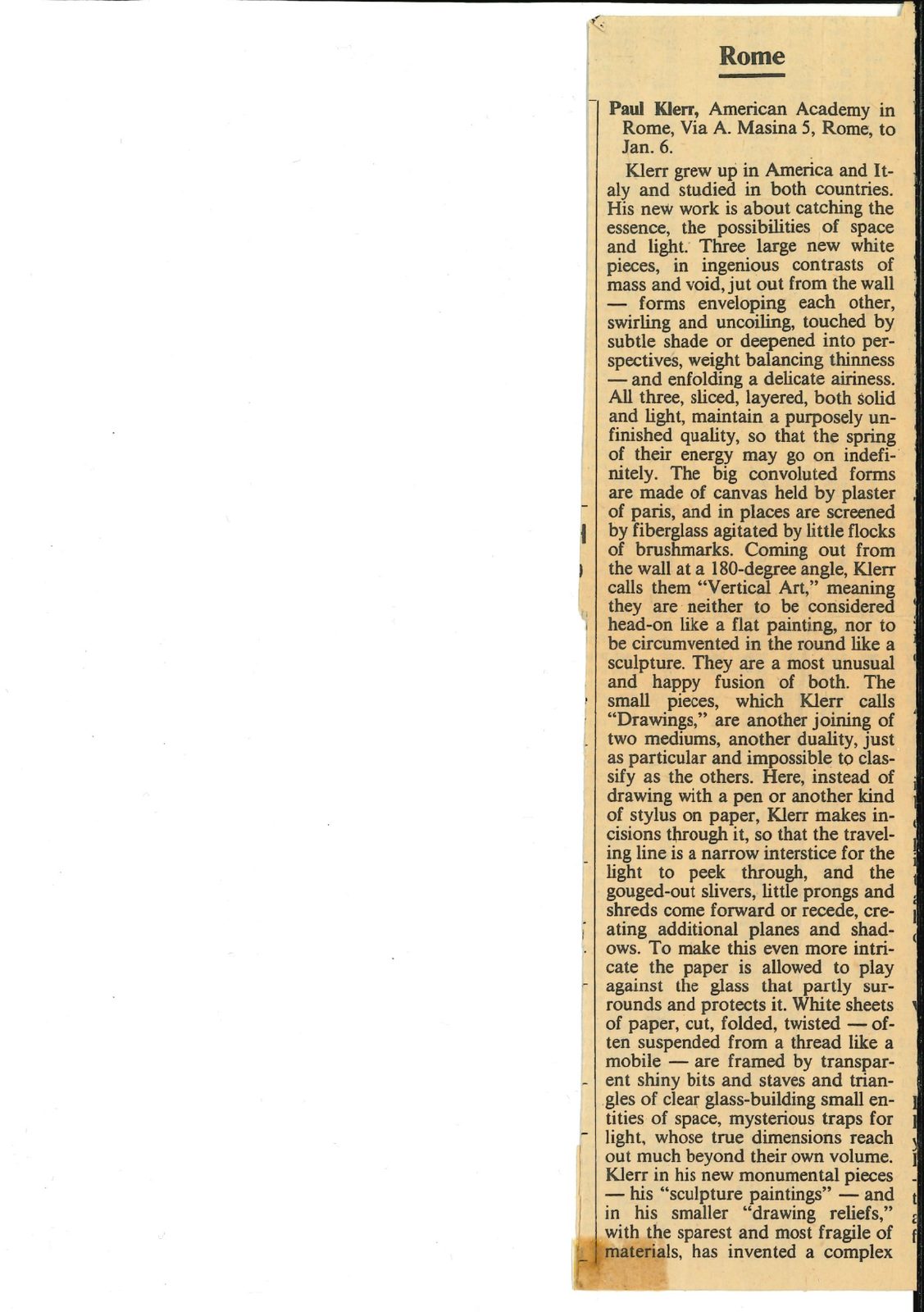
Critique en anglais de l'exposition « Vertical Art » à l'American Academy in Rome (11 décembre 1978 – 6 janvier 1979). Edith Schloss décrit trois grandes sculptures blanches qui font saillie du mur à 180°, qualifiées de « sculpture paintings », et les plus petits « drawing reliefs ». Texte crucial pour comprendre la théorie du Vertical Art comme fusion de peinture et sculpture.
Texte du document (recherchable)
Rome
'| Paul Klerr, American Academy in
Rome, Via A. Masina 5, Rome, to
Jan. 6.
Klerr grew up in America and It-
aly and studied in both countries.
His new work is about catching the
essence, the possibilities of space
and light. Three large new white
pieces, in ingenious contrasts of
mass and void, jut out from the wall
— forms enveloping each other,
swirling and uncoiling, touched by
subtle shade or deepened into per-
spectives, weight balancing thinness
— and enfolding a delicate airiness.
All three, sliced, layered, both solid
and light, maintain a purposely un-
finished quality, so that the spring
of their energy may go on indefi-
nitely. The big convoluted forms
are made of canvas held by plaster
of paris, and in places are screened
by fiberglass agitated by little flocks
of brushmarks. Coming out from
the wall at a 180-degree angle, Klerr
calls them “Vertical Art,” meaning
they are neither to be considered
head-on like a flat painting, nor to
be circumvented in the round like a
sculpture. They are a most unusual
and happy fusion of both. The
small pieces, which Klerr calls
“Drawings,” are another joining of
two mediums, another duality, just
as particular and impossible to clas-
sify as the others. Here, instead of
drawing with a pen or another kind
of stylus on paper, Klerr makes in-
cisions through it, so that the travel-
ing line is a narrow interstice for the
light to peek through, and the
gouged-out slivers, little prongs and
shreds come forward or recede, cre-
ating additional planes and shad-
ows. To make this even more intri-
cate the paper is allowed to play
against the glass that partly sur-
rounds and protects it. White sheets
of paper, cut, folded, twisted — of-
ten suspended from a thread like a
mobile — are framed by transpar-
ent shiny bits and staves and trian-
gles of clear glass-building small en-
tities of space, mysterious traps for
light, whose true dimensions reach
out much beyond their own volume.
Klerr in his new monumental pieces
— his “sculpture paintings” — and
in his smaller “drawing reliefs,”
with the sparest and most fragile of
ls, has invented a complex